
NEW Published June 2026.
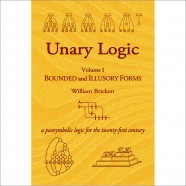
The Image is the cover of Unary Logic Volume I: Bounded and Illusory Forms. The concepts and content of this book are described in the four video talks in the adjacent panel.This book is the first of two volumes and is available from Amazon (ISBN 978-1-7324851-6-7).
From the back cover:
Reasoning without dualism and negation!
• Logic can reduced to nested boundaries.
• Truth changes to contextual relevance.
• Deduction is replaced by deletion.
• Falsity is eliminated entirely.
• Rationality is concrete, interactive, experiential.
More powerful than symbolic deduction
Three simple pattern-matching rules delete contextually
meaningless, redundant and irrelevant boundaries
to leave the simplest form of all possible conclusions.
Unary Logic: bounded and Illusory Forms introduces a radically different postsymbolic system for logical deduction that eliminates symbolic representation, all logical connectives, and logical dualism. Logic was formalized over a hundred years ago. But all the way back to Aristotle, logic has been about using the tools of language to maintain the difference between true and false. It is both fascinating and outrageous then that the results of logical deduction and optimization require neither abstract symbols nor negation nor truth-values.
Unary logic converts conventional logic into nesting of identical iconic containers. TRUE is abandoned in favor of contextual relevance. FALSE is entirely eliminated. Unary achieves logical optimization by deletion of meaningless, redundant and irrelevant patterns of containment. Three simple equations define illusory patterns that are equivalent to their own absence. Deletion of illusory structure efficiently achieves the same results as logical deduction. The Existential Graphs of Charles Sanders Peirce and especially the Laws of Form by George Spencer-Brown both foreshadow the void-based iconic reduction patterns of unary logic.
Unary logic provides powerful conceptual tools for untangling logical puzzles, for real-world problem solving, and for informed decision making. Postsymbolic logic presents two significant challenges: its unfamiliarity and its simplicity. Patterns of containment are easily recognized while deletion of irrelevant patterns requires no specialized skills or concentration, no remembering or rearranging, and no making sense of what it might mean to throw away meaningless containers. These features are also very useful for automated computation. Unary logic was first developed to manage large databases in AI expert systems and later to optimize silicon circuits with millions of logic gates.
Volume I specifies the design principles of unary logic, provides an historical context, and develops the conceptual foundations. The unary reduction equations are demonstrated to be significantly simpler and more efficient than conventional inference and deduction. A new technique of virtual querying utilizes illusory patterns to reduce tangled logic to its simplest form. Hundreds of examples of void-based reduction are provided, ranging from simple tautologies and theorems to complex deductive problems. Unary logic is visceral rather than abstract. Unary containers stand in place of physical objects that can be visualized, manipulated and experienced. Iconic forms look like what they mean. The volume concludes with a dozen interactive iconic dialects that express logical reasoning in the form of enclosures, networks, maps, flows, paths, rooms and stacks of blocks.
Narrated Video, September 2026
This 41 minute video Unary Logic includes a description of the 2026 book, and sections on postsymbolism, void-based deduction, illusory form, deductive queries and iconic dialects. Here is the link to the narrated video on Vimeo:
Unary Logic: Bounded and Illusory Forms
SAMPLES
PDF samples from Unary Logic Volume I are available below. The samples have a distinct right and left page format. Please set your PDF viewer (probably Acrobat) for View>PageDisplay>TwoPageView.
Volume I Samples: FIRST and LAST
The Unary Logic Sampler includes the contents, preface, bibliography and index of this first volume as well as Chapters 1, 2, 7 and 14.
Chapter 1 provides an overview of how to use unary logic for deduction.
Chapter 2 is an introduction to postsymbolism. Our visual interactive web culture has moved beyond the burden of memorizing the meaning of words.
Chapter 7 shows explicitly how the foundations of deductive reasoning are rather trivial when viewed from an iconic perspective.
Chapters 14 shows dozen visual and interactive dialects that support physical interaction with deduction.
Volume I: The MIDDLE
Chapters 3-5 describe the foundations of unary logic and the deletion rules of the arithmetic and algebra of boundaries.
Chapters 6 and 8 connect unary logic to symbolic logic and analyze the complexity of symbolic logic systems.
Chapters 9-12 introduce the primary innovation of unary logic, illusory queries. Illusory forms both exist and do not exist. We can use them to do deduction when they are helpful and discard them when they are in the way.
Chapter 13 briefly reconnects iconic dialects to symbolic notation and Chapter 15 even more briefly describes the content of Volume II.
For PURCHASE
The softcover physical book can be purchased directly from Amazon. The price is intended only to cover some of the development overhead.
Unary LogicVolume I: ($40), ISBN 978-1-7324851-6-7.
Thanks!
Your editorial comments and error corrections are most welcomed at wm@iconicmath.com